Enhancing Digital Projects with Shops and Stores Icon Sets
In the world of digital design, clarity and visual communication are paramount. Whether you're building a mobile app for a retail business, designing a website template for an e-commerce platform, or creating a presentation about market trends, you need visual elements that instantly convey meaning. This is where specialized icon sets, like a collection focused on Shops and Stores, become invaluable tools. They are more than just decorative graphics; they are a functional language that guides users, establishes context, and enhances the overall user experience.
What is a Shops and Stores Icon Set?
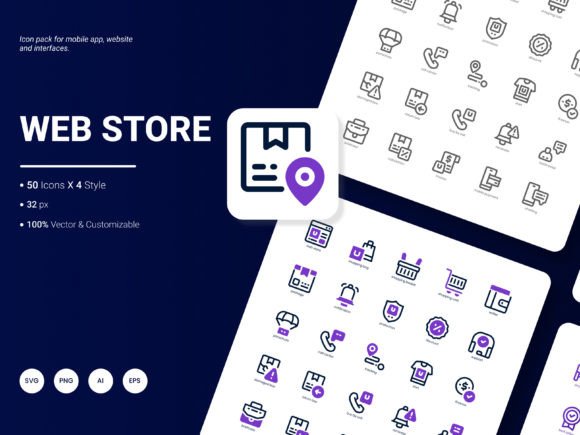
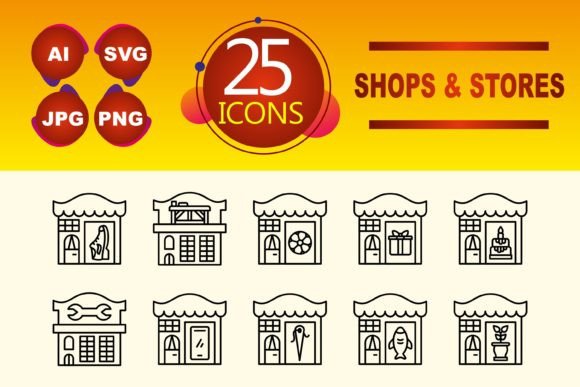
A Shops and Stores icon set is a curated collection of graphic symbols representing common concepts, objects, and actions associated with retail, commerce, and physical or online storefronts. The specific set described here includes 10 distinct icons rendered in a clean Line Icon style, characterized by outlined shapes without filled colors. This minimalist approach offers versatility and a modern aesthetic. Crucially, the set provides multiple file formats—AI, JPG, PNG, and SVG—making it ready for integration across virtually any project, from vector-based illustrations in Adobe Illustrator to scalable graphics on a website or pixel-perfect assets in a mobile app interface.
Common Challenges in Commercial Design Projects
Designers and developers working on commercial projects often face a set of recurring challenges. First is the need for immediate visual recognition. Users should understand an icon's purpose without hesitation—a shopping cart icon for checkout, a storefront icon for location, a price tag icon for deals. Creating custom icons that achieve this universal recognition is time-consuming and requires significant design skill.
Second is the issue of visual consistency. A project needs a cohesive look across all its screens and pages. Using disparate icons from various sources can lead to a jumbled, unprofessional appearance. Third is scalability and technical compatibility. Icons must render crisply on high-resolution displays, scale without loss of quality for different devices, and be compatible with the technical stack, whether it requires SVG for web interactivity or PNG for a mobile app asset catalog.
Finally, there's the challenge of time and resource efficiency. Searching for or creating appropriate icons diverts valuable time away from core design and development tasks, potentially delaying project timelines.
How a Shops and Stores Set Addresses Design Needs
A dedicated, high-quality Shops and Stores icon set directly solves these problems. By offering a pre-designed collection, it eliminates the need for custom icon creation, saving hours of design work. Since all icons share the same Line Icon style, they guarantee visual consistency from the moment they are implemented. The inclusion of multiple file types addresses technical needs: SVG files offer infinite scalability for web and responsive designs, AI files allow for customization in vector editing software, while PNG and JPG formats provide ready-to-use raster images for various contexts.
Most importantly, these icons are designed for semantic clarity. Each symbol in a Shops and Stores set is crafted to be intuitively understood, aligning with established user expectations. This reduces cognitive load for the end-user, making interfaces more navigable and presentations more persuasive. They act as visual shorthand, conveying complex ideas like "inventory," "payment," or "customer service" with a simple, elegant graphic.
Practical Applications and Outcomes
The utility of a Shops and Stores icon set extends across numerous digital mediums. In mobile app design, these icons can be used for tab bars, feature buttons, or status indicators within shopping, delivery, or retail management apps. A clear "store" icon for a location finder or a "bag" icon for a user's orders creates an immediate, intuitive navigation system.
For website templates, especially for e-commerce businesses, these icons enhance service pages, feature lists, and call-to-action sections. Illustrating services like "gift cards," "returns," or "shipping" with an icon improves page scannability and can increase user trust and engagement.
In presentations and infographics, Shops and Stores icons help visualize data and processes. A flowchart explaining a supply chain or a slide detailing retail metrics becomes more accessible and memorable when supported by relevant icons. For user interface design templates and prototyping tools, having these assets on hand accelerates the mockup process, allowing designers to quickly build realistic, communicative layouts for client reviews or user testing.
Recommendations and Implementation Considerations
When implementing a Shops and Stores icon set, consider a few best practices. First, maintain consistency in usage. Decide on a standard size and color for your icon set within the project to reinforce a unified design language. The Line Icon style is particularly adaptable, as you can easily change the stroke color to match your brand palette.
Second, use icons to support text, not replace it entirely. Icons are excellent for reinforcement and quick recognition, but critical actions or information should still have a textual label for clarity and accessibility. Third, leverage the SVG format whenever possible for web projects. SVG icons are scalable, lightweight, and can be styled with CSS, allowing for dynamic effects like color changes on hover.
Think about the context of your audience. For a technical developer, the SVG and AI files are the key assets, enabling integration and customization. For a marketing professional creating a presentation, the ready-made PNG or JPG files might be the most convenient. For a UX/UI designer, the entire set represents a cohesive component library to speed up wireframing and high-fidelity design.
Ultimately, a focused asset like a Shops and Stores icon set is a strategic resource. It shifts the focus from asset creation to problem-solving and implementation. By providing clear, consistent, and technically flexible visuals, it allows designers and developers to concentrate on building user-friendly experiences, compelling presentations, and effective commercial interfaces. Investing in such a set is an investment in efficiency, professionalism, and clear communication, ensuring your digital projects communicate their purpose as effectively as possible.