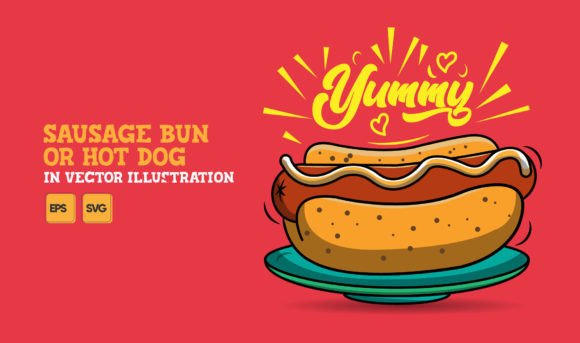
The Sausage Bun in Vector: More Than Just a Delicious Graphic
In the digital design landscape, where concepts need to be communicated quickly and clearly, the humble icon often carries immense weight. Consider a simple, universally recognized item like a sausage bun or a hot dog. As a static image, it might just represent food. But when transformed into a vector illustration, it becomes a versatile tool, a building block for communication. This discussion explores the profound utility of such assets, focusing on a hypothetical but representative collection: 100 vector illustrations of a sausage bun or hot dog, designed for maximum adaptability.
Why Vector Shape Layers Are the Core of Customization
The single most critical feature of a professional vector graphic asset is not its aesthetic style, but its underlying structure. The promise that it "comes with vector shape layers" is the gateway to true creative freedom. Unlike a raster image (like a JPEG or PNG), which is a fixed grid of pixels, a vector illustration is built from mathematical points, lines, curves, and shapes. When these elements are kept as editable, separate layers—as opposed to a flattened, merged final art—the user retains control.
This means the sausage bun isn't a single, immutable object. The bun, the sausage, the sesame seeds, the condiment drips—each is an independent shape. You can change the color of the bun from golden brown to a brand's signature blue. You can remove the sausage entirely and replace it with another symbolic element. You can enlarge the seeds, rearrange them, or turn them into a pattern. This granular control is what separates a disposable stock image from a foundational design resource.
Practical Scenarios for Editing Vector Layers
Imagine a food delivery startup whose logo is a stylized hot dog. Using a base vector hot dog illustration with editable layers, they can effortlessly create seasonal promotions: a green bun for a summer eco-campaign, or a bun decorated with tiny holiday lights for a December sale. A nutrition educator creating an infographic about processed foods can deconstruct the same illustration, isolating the sausage to label its components separately from the bun. The editable layers make these transformations logical, not laborious.
The Multi-Format Advantage: EPS and SVG
A quality vector pack offering both EPS and SVG files caters to different professional needs. EPS (Encapsulated PostScript) files are a longstanding standard in print and professional vector software like Adobe Illustrator. They reliably preserve complex vector data, layer information, and are ideal for high-quality print collateral like business cards, brochures, or signage where that 2000 x 2000 pixel size ensures crispness at any scale.
SVG (Scalable Vector Graphics) files, on the other hand, are the web's native vector format. Their high resolution translates perfectly to digital screens. Using an SVG of the sausage bun vector illustration on a website means it loads quickly, remains sharp on any device—from a mobile phone to a desktop monitor—and can often be manipulated further with CSS or JavaScript. This dual-format compatibility bridges the gap between offline and online branding needs seamlessly.
Flat Design Style: Aesthetic and Functional Benefits
The choice of a flat design style for such a collection is strategically smart. Flat design minimizes complex shadows, gradients, and textures, focusing on clean shapes, bold colors, and clear silhouettes. This makes the hot dog vector illustration exceptionally legible and impactful, especially in crowded visual environments like social media feeds or busy infographics.
From a practical editing standpoint, flat design is also simpler to modify. Changing a flat color is a single click. Altering a simple shape is more straightforward than tweaking a photorealistic texture. The style inherently supports the product's core promise of easy customization. Furthermore, flat design carries a modern, timeless tone that suits a wide range of businesses—from tech startups to contemporary educational platforms—avoiding the niche feel of overly stylized or retro graphic themes.
Direct Applications Across Professional Domains
The applications for 100 variations of a core concept like a sausage bun in vector format are surprisingly broad. Let's observe natural use cases without forced categorization.
For business branding, a consistent, customizable visual motif can be woven throughout identity. The vector hot dog could become a subtle pattern on packaging, a dynamic element in animated logo reveals, or a series of icons representing different product lines (a classic bun for the standard offer, a bun with premium toppings for the deluxe version).
In social media posts, having a library of 100 related illustrations prevents visual fatigue. A restaurant can post a different vector sausage bun graphic each week—one minimalist, one detailed with condiments, one split open to show ingredients—all while maintaining a cohesive brand look. The editable shapes allow quick creation of event-specific graphics: adding a number "50" to a bun for an anniversary sale, for instance.
For infographics and educational materials, the clarity of vector art is paramount. A public health entity explaining portion sizes could use a scalable vector bun graphic as a consistent measuring unit across charts. A history teacher creating a presentation on cultural food history could use editable vector illustrations to show the evolution of the hot dog across eras, changing details periodically with ease.
Hobbyists and content creators benefit from the ease of use. Someone running a food blog doesn't need advanced design skills; they can open an SVG file in a simple editor, change colors to match their blog palette, and instantly have unique, professional-looking graphics for their articles and videos, avoiding generic stock photo licenses.
Observations on Scale and Cohesion
A collection of 100 illustrations around a single theme raises an important consideration: cohesion versus variety. The value lies not in 100 random images, but in 100 systematic explorations of the subject. This might include the sausage bun viewed from different angles, in different states (whole, half-eaten, wrapped, unwrapped), with different accompanying items (on a plate, in a hand, as part of a meal spread), and in different stylistic weights within the flat design paradigm. This allows a user to build a visual narrative without the assets feeling disjointed.
The specified size of 2000 x 2000 pixels is a practical default. It provides a high-resolution starting point that can be scaled down for web use or printed moderately large without loss of quality. For extreme print sizes, the vector nature allows scaling beyond this base dimension infinitely.
Integration into Common Workflows
Compatibility with Adobe Illustrator is a key mention, as it is the industry standard for deep vector manipulation. However, the presence of SVG files also means compatibility with a wider ecosystem: free tools like Inkscape, web-based design platforms, and even presentation software that supports SVG import. This accessibility broadens the potential user base from corporate design teams to solo entrepreneurs and educators.
The workflow typically begins with selecting a base illustration from the library. The designer then opens the EPS or SVG file in their software, examines the layer panel to understand the construction—identifying the bun layer, the sausage layer, etc.—and then makes targeted adjustments. This process is fundamentally different from trying to edit a pixel-based image, where changes are destructive and limited.
A Note on Perceived Simplicity
One might think a vector illustration of a common food item is a simplistic resource. In practice, its simplicity is its strength. It is a clear, unambiguous symbol. Its power comes from the system it represents: a library of adaptable, scalable, and professionally constructed assets based on that symbol. It serves not as a finished piece of art, but as a raw material for creativity, much like a builder's lumber or a programmer's code library.
Ultimately, whether the central motif is a sausage bun, a hot dog, or any other recognizable item, the principles remain. The value is transferred from the image itself to the control over the image. This transforms a graphic from a static piece of content into a dynamic tool for branding, communication, and education, answering the needs of a diverse audience seeking efficiency, clarity, and creative autonomy in their visual projects.