Mental Health Icons: Visual Tools for a Crucial Conversation
In the digital age, visual communication is king. We use icons to navigate apps, understand interfaces, and grasp concepts instantly. When the subject is as nuanced and vital as mental health, having the right visual tools becomes more than a design choice—it’s a communication necessity. A dedicated set of Mental Health icons, available in clean Line Icon styles, serves as a bridge between complex emotional topics and user understanding, making them invaluable for designers, developers, and educators.
Why Specific Icons Matter for Mental Health Topics
Generic icons often fall short when depicting mental wellbeing. A simple smiley face can’t convey mindfulness, a heart doesn’t fully represent empathy, and a chat bubble might be too vague for support networks. Specific, well-crafted icons create a shared visual language. They allow a mobile app about meditation to instantly signal a breathing exercise, or a wellness website to visually categorize resources for anxiety versus depression. This specificity reduces cognitive load for the user. They don’t have to interpret a generic symbol; they immediately recognize the intended concept, making digital experiences in this space more intuitive and less stressful.
Consider a mental health awareness presentation. Slides filled with text-heavy statistics can feel overwhelming. Integrating a clear icon for “statistics” next to the data, an icon for “support” next to helpline information, and an icon for “progress” next to recovery pathways makes the information digestible and memorable. The icons act as visual anchors, guiding the audience through the sensitive material with clarity and respect.
The Practical Power of a Line Icon Style
The choice of a Line Icon style for this kind of content is particularly strategic. Line icons, characterized by their clean outlines, minimal detail, and often open forms, carry distinct advantages. First, they embody clarity and simplicity. Mental health topics can feel dense; the icons shouldn’t add visual clutter. Their simplicity ensures they remain secondary to the content itself, supporting it rather than dominating it.
Secondly, their scalability is exceptional. Whether displayed as a tiny button on a mobile app or blown up for a large infographic poster, line icons maintain their integrity and recognizability. This is crucial for responsive design across websites and apps. Finally, the style often conveys a sense of modernity and calm. The aesthetic is unobtrusive and thoughtful, matching the tone needed for most mental health-related projects.
Integrating Mental Health Icons into Modern Projects
These icons are not just decorative elements; they are functional assets that fit seamlessly into contemporary creative and educational workflows.
- Mobile App Development: For an app focused on mood tracking, therapy exercises, or community support, these icons can define the entire navigation. A “brain” icon for cognitive techniques, a “heart” icon for emotional wellbeing sections, and a “group” icon for community forums create an intuitive UI. Their availability in SVG ensures they render perfectly at any size on all devices.
- Website Templates & Educational Platforms: Wellness blogs, therapist directories, or non-profit resource sites use icons to visually segment content. Users quickly scan and find what they need—crisis resources symbolized by a specific icon, self-care tools by another. This improves user experience and engagement.
- Presentation & Infographic Design: When communicating data about mental health statistics, service gaps, or coping strategies, infographics are powerful. Icons become the visual shorthand that turns complex information into an accessible story. A line icon depicting “stress” next to a bar chart about workplace anxiety makes the data point instantly relatable.
- User Interface Design Templates: Designers creating wireframes or prototypes for digital products in the health and wellness sector can use this set as a standardized visual library. It speeds up the design process and ensures conceptual consistency from the very first mockup.
File Format Flexibility: From Design to Deployment
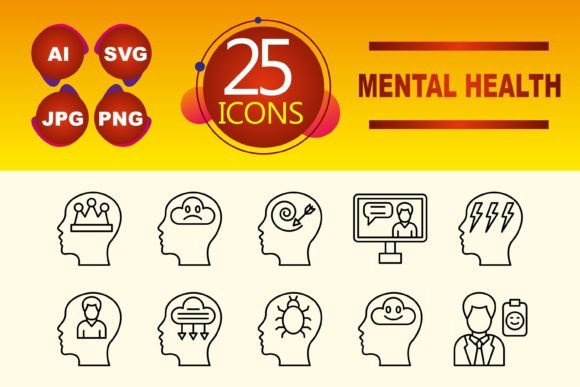
The inclusion of multiple file types—AI, JPG, PNG, and SVG—addresses the entire project lifecycle. The AI (Adobe Illustrator) file is the source for designers. It allows for customization, color changes, or stylistic adjustments to perfectly match a brand’s identity. The JPG and PNG files are ready-for-use raster images, ideal for quick placement in presentations, documents, or web graphics where vector editing isn’t needed.
The SVG file, however, is the star for modern digital implementation. As a vector format, it is infinitely scalable without loss of quality, essential for responsive web design. It’s also typically smaller in file size than raster images and can often be styled with CSS, allowing developers to change its color dynamically based on app states. This flexibility means the same Mental Health icon set can be used by a graphic designer creating a poster, a web developer coding an interactive resource page, and a marketer putting together a social media campaign.
Choosing and Using a Mental Health Icon Set: Key Considerations
Before adopting a set of icons like this, several factors warrant thought to ensure they truly enhance your project.
- Scope & Relevance: Does the set cover the concepts you need? A set of 10 icons should be evaluated for its range. Does it include symbols for both internal states (like mindfulness, resilience) and external actions (therapy, support)? Ensure the icons map to your content’s key themes.
- Visual Cohesion & Tone: The line style should match the overall emotional tone of your project. While clean and neutral, it should feel appropriate. For a serious, clinical resource, it might be perfect. For a more playful, youth-focused app, you might consider if customization of color or slight addition of weight is possible from the source AI files.
- Technical Compatibility: Check the required file formats for your workflow. If you’re building a web app, SVG support is critical. For a print brochure, high-resolution PNGs or the source AI file might be your focus. Ensure the provided formats align with your output channels.
- Cultural Sensitivity & Universality: Icons are cultural symbols. When dealing with mental health, it’s wise to consider if the icon designs are broadly understandable and free from unintended cultural connotations. The simplicity of line icons often aids in this universality.
Ultimately, a well-designed Mental Health icon set is more than a collection of graphics. It’s a toolkit for fostering understanding. By giving designers and communicators a consistent, clear, and flexible visual language, these icons help demystify mental wellbeing, making crucial resources easier to find, complex ideas easier to share, and supportive digital spaces easier to navigate. In a field where clarity and compassion are paramount, the right visual shorthand makes a significant difference.